Robot identity verification helps businesses confirm which robots are connected to their systems. It also helps teams control access and track robot activity.
As robot fleets grow, managing security becomes harder. Warehouses, hospitals, and factories now use robots for many daily tasks. However, each connected machine can introduce new risks.
Imagine a warehouse with 100 mobile robots. Suddenly, one enters a restricted area. Can your team identify the robot and check its access rights?
Without a trusted identity system, finding answers may take time.
Therefore, fleet managers need more than robot names or serial numbers. They need a reliable way to verify machines and review their actions.
This guide explains six key areas that robotics leaders should review.
1. Why Robot Identity Verification Matters
Most fleet dashboards show robot names, serial numbers, or network addresses.
These details help identify machines. However, they do not always prove that a robot is genuine.
For example, someone could copy a device label. A configuration error could also create duplicate records.
As fleets grow, these problems become harder to manage.
Three Common Business Risks
- Unauthorized Access: An unknown device may try to connect to fleet systems.
- Poor Traceability: Incorrect records can make incident reviews difficult.
- Higher Management Costs: Manual identity checks take more time as fleets expand.
Robot identity verification helps reduce these risks by connecting each machine to trusted credentials.
As a result, teams can make better access decisions and investigate unusual activity more easily.
2. Understand Trust Identity as a Service
Trust Identity as a Service describes an approach to managing trusted machine identities.
Instead of relying only on a robot’s visible name, the system checks its credentials.
This process helps answer three important questions:
- Identity: Is this the expected robot?
- Authentication: Can the robot prove its identity?
- Authorization: Is the robot allowed to perform this task?
Although these checks work together, they serve different purposes.
For example, a robot may have valid credentials but still lack permission to enter a restricted area.
Therefore, confirming identity alone is not enough.
The National Institute of Standards and Technology (NIST) also recognizes device identification and authentication as important IoT security capabilities.
Robotics operators can apply these same principles to improve fleet security.
3. Connect Robot Identity to Fleet Activity
A verified identity becomes more useful when teams can connect it to robot activity.
Consider a delivery robot working during a busy warehouse shift. Suddenly, it receives a new route.
The operations team should be able to identify the robot. They should also know where the command came from and what happened next.
Key Benefits for Fleet Operators
- Access Control: Allow approved robots to use specific systems and areas.
- Fleet Visibility: Track robot activity across locations and vendors.
- Incident Investigation: Connect unusual events to the machines involved.
- Operator Accountability: Review remote access and human interventions.
In addition, identity records must stay updated.
For example, teams may need to replace credentials after maintenance. They should also revoke access when a device is retired.
As a result, verified identities remain useful throughout a robot’s working life.
4. Improve Security Reviews and Audit Trails
Security teams need clear records when problems occur.
However, disconnected logs and incorrect device labels can slow an investigation.
Verified robot identities help connect events to specific machines. Therefore, teams can review activity with greater confidence.
What Should an Audit Trail Include?
- The identity of the robot involved
- The time and location of the event
- Commands received and actions recorded
- Any unusual activity or system alerts
- Human access and remote interventions
- Steps taken to review or resolve the issue
In addition, records need secure storage and clear retention rules.
An audit trail is only useful when its information is accurate and available to authorized reviewers.
Most importantly, identity verification does not guarantee safe robot behavior. It must work alongside monitoring, access controls, and human oversight.
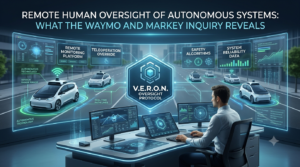
5. How V.E.R.O.N. Supports Robot Identity Verification
V.E.R.O.N., the Verified Robotics Operations Network, helps organizations improve trust and visibility across robotic operations.
The platform acts as a verified intelligence layer for connected robot systems.
Instead of focusing only on device records, V.E.R.O.N. brings identity verification and operational monitoring together.
Key V.E.R.O.N. Capabilities
- Robot Identity Verification: Helps establish trusted identities for connected robots.
- Fleet Monitoring: Uses AI-assisted video and telemetry to provide operational visibility.
- Route Verification: Helps teams review robot movement and route activity.
- Anomaly Detection: Identifies unusual activity that may need attention.
- Teleoperation Support: Supports authenticated remote robot operations.
- Audit Trails: Records operational events for later investigation.
- Vendor-Neutral Integration: Supports connections across different robotic ecosystems.
For example, imagine a robot taking an unexpected route.
A fleet manager needs to identify the machine and understand its activity. V.E.R.O.N. helps connect identity information with operational evidence.
As a result, teams can investigate unusual movement without relying only on disconnected records.
Furthermore, V.E.R.O.N. builds on Proctortrack’s stated 14-plus years of experience in trust infrastructure.
This background informs its approach to identity checks and monitoring.
However, businesses should still test integration, permissions, and security controls before deployment.
6. Robot Identity Verification Checklist
Before expanding your robot fleet, review these important security checks.
Identity and Access
- Does every robot have a unique, verifiable identity?
- Can the system reject unknown or revoked credentials?
- Are robot permissions clearly defined?
- Can teams manage access for remote operators?
Monitoring and Visibility
- Can the system connect activity to a specific robot?
- Are unusual movements and commands recorded?
- Can authorized teams review operational events?
Security and Audits
- Are activity logs stored securely?
- Can teams investigate incidents using reliable records?
- Are credential updates and access changes documented?
These checks can help businesses identify security gaps early.
In addition, regular reviews support more consistent fleet management as operations grow.
Frequently Asked Questions
What is robot identity verification?
Robot identity verification checks whether a connected robot has a trusted identity. It helps teams recognize machines and support secure access decisions.
Why do autonomous fleets need verified identities?
As fleets expand, more machines connect to business systems. Therefore, verified identities help teams manage access, review activity, and investigate incidents.
Is identity verification enough to secure a robot fleet?
No. Identity checks are only one part of robot security. In addition, businesses need monitoring, access controls, reliable records, and human oversight.
How does V.E.R.O.N. help fleet operators?
V.E.R.O.N. combines robot identity verification with monitoring and operational intelligence. As a result, teams can gain better visibility into robot activity and unusual events.
Conclusion: Give Every Robot an Identity You Can Trust
Robot identity verification is an important step toward safer and more accountable robotic operations.
As fleets grow, businesses need to know which machines are active, what they can access, and how they behave.
Therefore, identity checks should work alongside monitoring and incident reviews.
V.E.R.O.N. brings robot identity verification, fleet visibility, unusual activity alerts, supported teleoperation, and audit trails into one approach.
Together, these capabilities help operators improve oversight across connected robotic systems.
Is your robot fleet growing faster than your ability to monitor it?
Explore how V.E.R.O.N. can support trusted identities and operational visibility across your fleet.