Introduction
Hiring the right candidate is about more than finding someone with an impressive résumé or conducting a successful interview. Organizations also need confidence that candidates are who they claim to be, have the skills they present, and complete assessments and interviews fairly.
As recruitment becomes increasingly digital, hiring teams face new challenges. Résumés may contain inaccurate information, candidate identities may need additional verification, and remote assessments can create opportunities for unauthorized assistance or impersonation.
This is where hiring integrity becomes important.
Hiring integrity refers to the practices, processes, and technologies organizations use to support authenticity, fairness, and trust throughout the recruitment process.
It does not mean treating every candidate with suspicion. Instead, it means creating a consistent hiring process where qualifications, identity, skills, and assessment performance can be evaluated responsibly.
This guide explains what hiring integrity means, where it applies across the recruitment lifecycle, why it matters today, and how talent teams can start improving their hiring processes.
1. Understand What Hiring Integrity Means
Hiring integrity is the practice of maintaining authenticity and fairness at every important stage of recruitment.
It helps organizations verify candidate information, evaluate genuine skills, and identify potential inconsistencies during the hiring process.
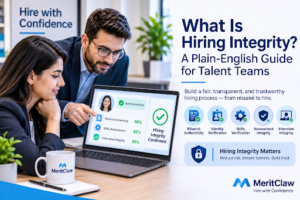
Hiring integrity can cover several areas:
- Résumé authenticity: Reviewing whether the qualifications and experience presented by candidates are accurate.
- Identity verification: Confirming that candidates are the individuals they claim to be.
- Skills verification: Evaluating whether candidates genuinely demonstrate the skills required for a position.
- Assessment integrity: Supporting fair and authentic participation in online assessments.
- Interview integrity: Identifying potential impersonation or unauthorized assistance during remote interviews.
These areas work together to help hiring teams make better-informed decisions.
Hiring integrity is not about eliminating every possible risk. It is about establishing reliable processes that support trust between employers and candidates.
2. Understand Hiring Integrity Across the Recruitment Lifecycle
Hiring integrity should not be limited to one stage of recruitment. It is relevant throughout the candidate journey.
Here are four important stages where organizations can apply integrity practices.
Stage 1: Résumé and Application Screening
The recruitment process usually begins with a résumé or job application.
Candidates provide information about their education, professional experience, certifications, skills, and previous responsibilities.
Hiring teams need to evaluate whether this information matches the job requirements and appears consistent.
Useful practices include:
- Reviewing employment history and qualifications.
- Checking relevant certifications where appropriate.
- Comparing candidate experience with job requirements.
- Identifying inconsistencies that may require clarification.
- Using structured résumé screening processes.
AI-assisted résumé analysis and job-description matching can help recruiters organize candidate information and identify relevant qualifications.
However, automated matching should support recruiter evaluation rather than replace it.
Stage 2: Candidate Identity Verification
Confirming candidate identity is another important part of hiring integrity.
Remote recruitment makes it possible to interview and assess candidates from different locations. However, organizations may need additional confidence that the person completing an assessment or interview is the actual applicant.
Identity verification may involve:
- Reviewing government-issued identification documents.
- Comparing identity information with candidate records.
- Using photographs or webcam captures.
- Applying facial biometric reference templates where configured and legally permitted.
- Confirming identity during relevant assessment or interview stages.
These checks can help reduce the risk of impersonation and unauthorized participation.
Organizations should clearly explain identity verification requirements and how related personal information is handled.
Stage 3: Skills and Assessment Verification
A résumé may describe a candidate’s abilities, but employers also need opportunities to evaluate those skills.
Skills assessments help organizations understand whether candidates can demonstrate the knowledge and abilities required for a particular role.
Hiring teams can support assessment integrity through:
- Role-specific skills assessments.
- Consistent evaluation criteria.
- Appropriate assessment instructions.
- Monitoring for potential unauthorized assistance.
- Reviewing assessment submissions and performance.
- Investigating unusual activity when necessary.
AI-assisted assessment tools can support assessment delivery, scoring assistance, and integrity monitoring.
The objective is to understand a candidate’s actual capabilities rather than relying only on information presented in an application.
Stage 4: Interview Integrity
Interviews give employers an opportunity to evaluate communication, problem-solving, professional experience, and role-specific knowledge.
However, remote interviews may introduce additional integrity concerns, including impersonation or unauthorized assistance.
Interview integrity practices may include:
- Verifying candidate identity.
- Monitoring relevant interview activity.
- Identifying potential unauthorized applications or devices.
- Reviewing unusual integrity alerts.
- Maintaining consistent interview guidelines.
Technology can help highlight potential concerns, but an alert should not automatically be treated as proof of misconduct.
Human reviewers should examine relevant information before making decisions.
3. Why Hiring Integrity Matters More Today
Hiring integrity has become increasingly important as organizations adopt remote recruitment, AI-assisted hiring tools, and digital assessments.
Here are some reasons talent teams should pay attention to it.
Reduces the Risk of Candidate Misrepresentation
Inaccurate qualifications, misleading employment history, and identity-related concerns can make recruitment decisions more difficult.
Verification practices help organizations examine important candidate information more carefully.
Supports Fairer Hiring Decisions
A consistent evaluation process helps ensure that candidates are assessed against relevant job requirements rather than inconsistent or unclear standards.
Protects Assessment Authenticity
Organizations invest time and resources in evaluating candidate skills. Maintaining assessment integrity helps ensure that results provide meaningful information about candidate capabilities.
Builds Employer Confidence
Hiring teams need confidence in the information they use to make recruitment decisions.
Reliable verification and review processes can support greater trust in candidate evaluations.
Supports Responsible AI Adoption
AI can help identify patterns, organize information, and generate decision-support indicators.
However, organizations need appropriate human oversight to ensure that technology supports fair and accountable hiring practices.
4. How HR and Talent Teams Can Start Small
Building a complete hiring integrity program does not need to happen all at once.
Organizations can begin with a few practical improvements and expand their processes as recruitment requirements evolve.
Here are five steps to consider.
Step 1: Identify Your Current Hiring Risks
Review your existing recruitment process and identify where additional verification may be useful.
For example, consider whether your organization has clear processes for checking qualifications, confirming candidate identity, and reviewing remote assessment activity.
Step 2: Prioritize Important Recruitment Stages
You do not need to introduce additional checks at every stage immediately.
Start with the areas where authenticity matters most, such as identity verification before assessments or monitoring during high-stakes remote interviews.
Step 3: Create Consistent Evaluation Guidelines
Establish clear criteria for reviewing résumés, assessing skills, and evaluating interview performance.
Consistent guidelines help recruiters apply similar standards across candidates.
Step 4: Introduce Appropriate Technology
Consider tools that support résumé analysis, identity verification, assessment monitoring, and interview integrity.
Choose technology based on your organization’s requirements, privacy obligations, and recruitment workflows.
Step 5: Keep Human Reviewers Involved
Technology should provide useful information to hiring teams, not make every decision independently.
Ensure that authorized human reviewers can examine relevant alerts, understand the context, and make informed hiring decisions.
Helpful tip: Start with one recruitment stage, evaluate the results, and gradually expand your hiring integrity practices.
5. The Role of AI and Human Oversight in Hiring Integrity
AI is becoming an important part of modern recruitment. It can assist with résumé analysis, job-description matching, identity verification, assessment scoring assistance, and integrity event detection.
However, responsible AI use requires clear boundaries.
For example, AI-generated scores, alerts, and recommendations should be treated as decision-support information rather than final hiring decisions.
MeritClaw follows this approach by providing indicators such as:
- JD Fit Score.
- Authenticity Score.
- Assessment Score.
- Integrity Score.
These indicators are intended to support human reviewers.
MeritClaw does not make automated hiring decisions, automatically reject candidates, perform emotion recognition, or infer protected characteristics.
Human reviewers remain responsible for final employment and hiring decisions.
This combination of AI-assisted analysis and human oversight helps organizations use technology while maintaining accountability.
6. How MeritClaw Supports Hiring Integrity
MeritClaw by Verificient Technologies is an AI-powered hiring integrity platform designed to support organizations throughout the recruitment lifecycle.
The platform brings together capabilities that help hiring teams evaluate candidate authenticity, identity, skills, assessment performance, and interview integrity.
Its capabilities include:
- Résumé analysis and job-description matching.
- AI-assisted candidate skill conversations.
- Candidate identity verification.
- Skills assessment delivery and monitoring.
- Interview integrity monitoring.
- Incident detection and reporting.
- Integrity scoring and reporting.
- HR review dashboards and analytics.
By bringing these capabilities together, MeritClaw helps organizations gain additional visibility into different stages of recruitment.
Its decision-support indicators are designed to assist human reviewers rather than replace their judgment.
Organizations can also review the MeritClaw Privacy Policy to understand how candidate information may be collected, processed, and protected.
7. Frequently Asked Questions About Hiring Integrity
Q1. What is hiring integrity?
Hiring integrity refers to the practices and processes organizations use to support authenticity, fairness, and trust throughout recruitment, including résumé screening, identity verification, skills assessments, and interviews.
Q2. Why is hiring integrity important?
It helps organizations identify potential misrepresentation, verify candidate information, maintain assessment authenticity, and make better-informed hiring decisions.
Q3. What are the main areas of hiring integrity?
The main areas include résumé authenticity, candidate identity verification, skills verification, assessment integrity, and interview integrity.
Q4. How does AI support hiring integrity?
AI can assist with résumé analysis, job matching, identity verification, assessment scoring assistance, and identifying potential integrity concerns. Human reviewers remain responsible for final hiring decisions.
Q5. Does hiring integrity monitoring automatically reject candidates?
No. MeritClaw does not automatically reject candidates or make automated hiring decisions. Its alerts, scores, and recommendations are designed to support human review.
Q6. How can small HR teams improve hiring integrity?
Small HR teams can start by standardizing résumé checks, verifying candidate identity where appropriate, using consistent skills assessments, and establishing clear interview review guidelines.
8. Build a More Trustworthy Hiring Process
Hiring integrity is not a single verification step. It is an ongoing approach to maintaining authenticity and fairness throughout recruitment.
From reviewing résumés and verifying identities to evaluating skills and monitoring remote interviews, every stage provides an opportunity to improve the reliability of hiring decisions.
Organizations do not need to introduce every solution immediately. Starting with the most important recruitment risks, establishing consistent guidelines, and keeping human reviewers involved can make a meaningful difference.
As recruitment continues to evolve, combining appropriate technology with human oversight can help talent teams build more transparent, reliable, and trustworthy hiring processes.
Explore Hiring Integrity Solutions with MeritClaw
MeritClaw helps organizations support hiring integrity through AI-powered résumé analysis, identity verification, skills assessment monitoring, and interview integrity capabilities.
With decision-support insights and human oversight, MeritClaw helps talent teams evaluate candidate authenticity and make more informed recruitment decisions.
Learn more about hiring integrity solutions at MeritClaw.
Subscribe for more insights on hiring integrity, AI-powered recruitment, candidate verification, and responsible hiring practices.
Read Next: Explore related MeritClaw resources to learn more about interview integrity monitoring and candidate identity verification.