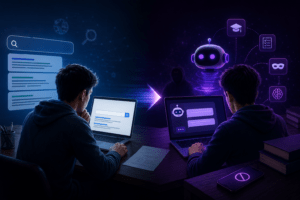
For years, online assessment security focused on one primary concern: candidates searching for answers during exams. Institutions responded by restricting browser access, blocking websites, and monitoring search activity to preserve exam integrity.
That strategy worked until the way people searched for information changed.
Today, candidates no longer need to browse multiple websites or search through pages of results. AI-powered chatbots can generate explanations, solve coding problems, write essays, and answer complex analytical questions within seconds. The challenge has shifted from detecting search behavior to identifying AI-assisted decision-making.
This is more than a technology trend. It represents a fundamental change in how assessment fraud operates. For institutions managing academic assessments and organizations focused on remote hiring assessment security, AI cheatbots are creating integrity risks that traditional online security measures were never designed to address.
The First Shift: From Information Retrieval to Instant Answers
Search engines require effort.
Candidates must identify keywords, review multiple sources, compare information, and determine which answer is relevant.
AI cheatbots remove that entire process.
Instead of searching, candidates simply ask a question and receive a complete response almost instantly. Many of these advanced AI systems are built using Generative AI Development Services, enabling them to generate mathematical solutions, programming scripts, case study analyses, and written explanations within seconds. AI delivers structured answers almost instantly, making it increasingly difficult for traditional assessment security measures to detect AI-assisted responses.
This changes the nature of online misconduct.
The issue is no longer unauthorized internet access. It is unrestricted access to instant expertise.
As AI tools become increasingly accessible, institutions can no longer assume that restricting search engines alone is enough to maintain assessment integrity.
The Micro Gap: AI Assistance Leaves Fewer Visible Signals
Traditional online cheating often created detectable patterns.
Candidates frequently:
- switched browser tabs,
- searched multiple websites,
- copied and pasted information,
- or spent long periods navigating external resources.
AI cheatbots have reduced many of these behaviors.
A candidate can now receive complete responses through a single interaction with minimal disruption to the assessment session using automated content creation. The time spent searching decreases, while the quality of externally generated answers improves.
This creates a significant challenge for organizations attempting to prevent cheating in pre-employment tests.
particularly those relying on an AI Recruiter to screen and evaluate candidates at scale.
Candidates may appear focused throughout the assessment while using AI-generated responses that are difficult to distinguish from independent work.
The integrity risk is no longer excessive browsing activity. It is seamless AI-assisted performance.
When Browser Restrictions Are No Longer Enough
Many assessment strategies were developed when search engines represented the primary external resource.
Today’s assessment environment is very different.
AI-powered tools are now available through:
- browser extensions,
- desktop applications,
- mobile devices,
- integrated productivity platforms,
- and voice assistants.
Blocking websites alone does not eliminate these risks.
Candidates no longer need to navigate dozens of web pages. A single AI interaction can provide:
- complete written responses,
- optimized code,
- analytical summaries,
- and step-by-step problem-solving guidance.
For institutions responsible for remote hiring assessment security, this changes how assessment environments must be secured.
The focus is shifting from monitoring internet activity to controlling access to AI-enabled assistance during the assessment itself.
The Overlooked Detail: AI Is Changing Assessment Design
The rise of AI cheatbots is not only changing how candidates cheat.
It is changing how assessments should be designed.
Questions that rely heavily on factual recall or predictable responses are increasingly vulnerable to instant AI assistance.
Institutions are now rethinking how they evaluate:
- critical thinking,
- practical decision-making,
- applied problem-solving,
- and authentic reasoning.
At the same time, organizations working to prevent cheating in pre-employment tests are combining stronger identity verification, secure assessment environments, behavioral monitoring, and adaptive question formats to reduce opportunities for AI-assisted misconduct.
The objective is no longer simply detecting AI-generated answers.
It is ensuring that submitted responses genuinely reflect the candidate’s own knowledge and abilities.
The Future of Online Assessment Integrity
Search engines transformed access to information.
AI cheatbots are transforming access to expertise.
This distinction matters because online assessments were designed for a world where finding information still required effort. That assumption no longer holds true.
As AI continues to evolve, institutions will need integrity strategies that move beyond traditional browser monitoring and search restrictions.
The future of assessment security will depend on protecting the entire testing environment while validating authentic candidate performance.
Because the next generation of online misconduct will not be defined by what candidates search for.
It will be defined by what AI can generate before anyone realizes it was involved.