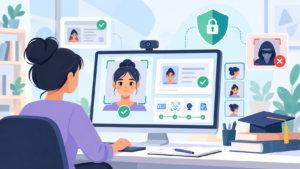
The person answering an online exam may not always be the person who registered for it. As remote assessments expand across universities, certification programs, professional training, and corporate hiring, proxy test-takers create a different kind of exam-integrity problem. Instead of finding answers during an exam, a candidate can attempt to outsource the assessment itself.
This makes identity one of the most important layers of online exam security.
A difficult question bank, browser restrictions, and AI monitoring have limited value if an institution cannot confidently establish who is actually sitting for the exam.
Proxy Testing Changes the Online Cheating Problem
Traditional academic misconduct usually focuses on what a candidate does during an assessment.
Proxy testing changes the question completely.
Instead of asking, “Did this person receive unauthorized assistance?” exam administrators must first ask, “Is this actually the registered candidate?”
Online environments can make that question more complex because the candidate and institution are physically separated. Research into online examinations has consequently examined identity controls, monitoring, browser restrictions, and other mechanisms as complementary approaches to maintaining integrity.
The growth of remote assessments also means the impact extends beyond universities.
Certification organizations need confidence that a credential belongs to the individual who demonstrated the required knowledge. Employers need confidence that assessment results accurately represent a job candidate. Training providers need confidence that the person receiving a qualification actually completed the required evaluation.
When identity cannot be trusted, the credibility of the result itself becomes questionable.
How Proxy Test Takers Create Institutional Risk
Proxy testing is particularly concerning because it can bypass controls designed primarily to detect conventional cheating.
A secure browser may successfully prevent internet searches and unauthorized applications. But browser security alone does not establish that the authorized person is operating the computer.
The problem can appear in several forms.
A different individual could attempt to complete an assessment using another candidate’s account. Someone could attempt to present inaccurate identity information. The registered candidate could begin a session, and another person could attempt to participate later.
The details may differ, but the underlying vulnerability remains the same.
Authentication at login is not always enough.
For higher-stakes assessments, identity assurance must extend throughout the testing process.
This is why modern exam integrity solutions increasingly combine identity verification with ongoing monitoring and contextual evidence. Research into automated proctoring has similarly explored continuous face verification alongside behavioral analysis and other signals rather than treating authentication as a single moment at the beginning of an exam.
Why Identity Verification Must Become Continuous
A student ID check before an exam is useful, but institutions need to consider what happens after verification.
If identity is confirmed only once, administrators have limited assurance that the same individual remained responsible for the assessment throughout the session.
A stronger model establishes identity before the exam and continues verifying relevant signals during the assessment.
This is an area where Proctortrack provides a more layered approach.
ProctorTrack uses multi-factor biometric authentication to verify test-taker identity upon entry to an assessment. Its platform also provides identity verification information alongside recorded examination evidence so administrators can review events in context.
Proctortrack also describes continuous identity verification during exams, helping institutions move beyond a simple login credential or one-time identity check.
That distinction is critical to reducing the risk posed by proxy test takers in online exams.
How Proctortrack Helps Prevent Proxy Testing
Protecting an assessment from impersonation requires more than one security feature. Proctortrack combines several capabilities that address different stages of candidate authentication and exam integrity.
Biometric Identity Verification
Proctortrack creates a baseline identity profile via VeriPass using biometric data, including facial recognition and ID verification. Its identity process can also incorporate identity checks designed to protect against the use of forged documents.
This provides institutions with a stronger foundation for their identity before an assessment begins.
Continuous Identity Verification
Verification should not end once a candidate gains access to the exam.
Proctortrack supports continuous identity verification during an assessment, ensuring identity assurance remains part of the entire testing session rather than being a single authentication event.
For institutions concerned about candidate substitution, this provides an important additional layer.
Automated and Live Proctoring
Different assessments carry different levels of risk.
Proctortrack supports automated proctoring, live proctoring, and record-and-review models. This allows organizations to align the degree of supervision with the importance and security requirements of the assessment.
A university quiz may not require the same oversight as a professional certification exam. A layered proctoring model gives administrators greater flexibility.
Video and Exam Environment Evidence
Identity issues rarely exist in isolation.
Proctortrack exam reports can include identity verification information, desktop screenshots, and video playback from the candidate’s testing environment, providing administrators with contextual evidence when reviewing possible integrity concerns.
The goal is not to treat an automated signal as an accusation. It is to provide authorized reviewers with more information to make an informed decision.
Secure Browser Controls
Identity verification solves one part of the integrity problem, while browser security addresses another.
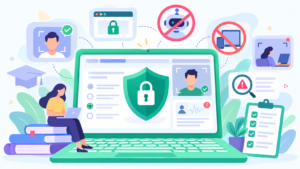
Proctortrack solutions can combine identity verification with secure browser controls, helping institutions protect both who is taking the exam and what can be accessed during the exam.
Together, these controls create a more comprehensive approach than either authentication or browser lockdown alone.
Identity Is Becoming the Foundation of Exam Integrity
The rise of proxy testing highlights an important shift in the security of online assessments.
Institutions cannot focus exclusively on preventing candidates from searching for answers, opening unauthorized applications, or consulting outside materials. They must also establish confidence that the person earning the score is the one authorized to take the assessment.
That requires a layered strategy.
Identity verification establishes who enters the exam.
Continuous identity verification helps maintain assurance throughout the session.
Secure browser technology protects the testing device.
Automated monitoring supports scalability.
Live proctoring provides additional oversight when assessment risk requires it.
Recorded evidence gives administrators context for review.
Proctortrack brings these capabilities together within a broader exam integrity framework, with solutions spanning biometric identity verification, automated proctoring, live proctoring, browser controls, monitoring, and review workflows.
Conclusion
Proxy testing demonstrates why the future of online exam security begins with identity. Institutions need confidence not only that assessment rules were followed, but also that the registered candidate genuinely completed the examination.
By combining biometric identity verification, continuous identity assurance, secure browser controls, automated monitoring, live proctoring, and contextual exam evidence, Proctortrack helps universities, certification organizations, EdTech providers, and enterprise assessment teams build a stronger defense against proxy testing.
As assessments continue to move online, protecting credentials will increasingly depend on linking every exam result to a verified individual.