The hiring funnel has quietly become one of the most targeted attack surfaces in modern enterprises. Not through obvious impersonation, but through something far more subtle: credential stuffing. Originally a cybersecurity concern, it is now reshaping how candidates infiltrate skill assessments using stolen identities, reused credentials, and automated access patterns.
In remote hiring ecosystems, this is not just fraud; it is a system design failure. When employers cannot distinguish between a legitimate candidate and a credential-driven impostor, remote hiring fraud detection becomes less about catching anomalies and more about questioning the authenticity of every assessment outcome.
Credential Stuffing Is No Longer Just a Login Problem
Credential stuffing traditionally meant attackers using leaked usernames and passwords to gain access. In hiring, it has evolved.
Fraudsters now use compromised identities and personal data to enter assessment platforms as legitimate candidates. These identities often pass initial verification because they are built on real data.
The problem intensifies in skill assessments. Once inside, the attacker does not need to stay. They can hand off the session, automate responses, or orchestrate external support.
This is where remote hiring fraud detection begins to fail. Systems are designed to verify entry, not continuity. The smallest gap is not identity creation, but identity persistence.
The Micro Gap: Session Ownership Drift
One of the least discussed vulnerabilities is what happens after login.
Credential stuffing enables a candidate to authenticate legitimately, but the session can then drift. Another individual, a proxy expert, or even an AI-assisted system takes over mid-assessment.
This is not traditional cheating. It is a session substitution.
Industries like IT services, consulting, and fintech are especially exposed. Technical hiring often relies on timed coding or problem-solving tests. If employers cannot prevent cheating in hiring assessments at the session level, they are effectively evaluating someone else’s skill.
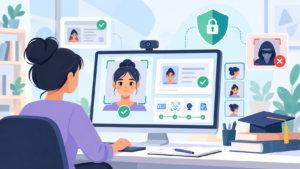
This is where platforms like Proctortrack introduce a critical shift. Instead of verifying identity only at entry, Proctortrack continuously authenticates candidates using biometric signals such as face, ID, and behavioral patterns throughout the session.
That continuity closes the smallest but most dangerous gap.
Automation Meets Scale: When Fraud Becomes Industrialized
Credential stuffing is scalable. That is what makes it dangerous.
With access to breached datasets, attackers can test thousands of identities across multiple hiring platforms. When combined with automation tools, this creates a pipeline in which fraudulent candidates enter assessments simultaneously.
This is where remote hiring fraud detection must evolve beyond rule-based systems. Static checks cannot keep up with dynamic, automated fraud patterns.
Proctortrack addresses this through AI-driven behavioral analysis and automated flagging of suspicious activities during assessments.
Global enterprises hiring across regions such as Southeast Asia, Eastern Europe, and Latin America benefit from such scalable monitoring, especially when hiring volume and geographic spread amplify risk.
The Illusion of Fairness: When Honest Candidates Lose
Credential stuffing does not just impact employers. It distorts the candidate ecosystem.
When fraudulent candidates use enhanced setups, external help, or AI augmentation, genuine candidates are indirectly penalized. The assessment benchmark shifts.
In university hiring programs, graduate recruitment, and early career pipelines, this creates a silent bias. Employers think they are selecting top talent, but they are selecting optimized environments.
To truly prevent cheating in hiring assessments, organizations must ensure that evaluation conditions are consistent and controlled, not just outcomes.
Proctortrack enables this through secure browser environments and system-level controls that block unauthorized applications, AI tools, and external access during assessments.
This ensures every candidate operates within the same controlled environment, restoring fairness.
From Detection to Environment Control
Most organizations focus on detection. But credential stuffing exposes a deeper truth: detection alone is reactive.
The future lies in controlling the assessment environment itself.
Proctortrack offers a layered approach through solutions like ProctorLock for browser lockdown, ProctorAuto for fully automated monitoring, and ProctorLive AI for real-time intervention.
It monitors candidates across multiple layers, including operating system, screen activity, user behavior, and room environment.
This matters across departments:
- Talent Acquisition: Ensures candidate authenticity from screening to final evaluation
- L&D Teams: Maintains integrity in internal certifications
- Compliance Teams: Reduces regulatory exposure
- Enterprise Security: Prevents compromised hires from entering critical systems
Here, remote hiring fraud detection is not an add-on. It is embedded into the assessment infrastructure.
The Small Detail That Changes Everything
If there is one detail employers overlook, it is timing.
Credential stuffing attacks often occur during high-volume hiring cycles. Graduate hiring seasons, bulk recruitment drives, and rapid scaling phases create noise. Fraud hides in volume.
A candidate logging in with valid credentials is not suspicious. A slight delay is not suspicious. A momentary screen deviation is not suspicious.
But together, they form a pattern.
Proctortrack’s combination of AI monitoring and human review ensures that these micro-signals are not evaluated in isolation but as part of a larger behavioral narrative.
To prevent cheating in hiring assessments, organizations must shift from isolated signals to continuous intelligence.
Credential stuffing in skill assessments is not about hacking systems. It is about exploiting assumptions.
The assumption that a verified login equals a verified candidate. The assumption that performance equals capability. The assumption that scale does not compromise scrutiny.
Solutions like Proctortrack demonstrate that integrity is not enforced at a single checkpoint but sustained across the entire assessment lifecycle through identity verification, secure environments, and continuous monitoring.
Because in modern hiring, the real question is no longer who applied. It is who actually showed up and stayed.