Remote certifications were designed to make professional credentials more accessible. Candidates can now complete high-stakes exams from virtually anywhere, reducing travel costs, administrative overhead, and testing center dependencies.
But convenience has created a new challenge.
As certification programs move online, the assessment environment becomes harder to control. Candidates now have access to multiple screens, AI-powered assistants, browser extensions, screen-sharing tools, and real-time collaboration platforms—all from the same device used to take the exam.
This shift has changed the integrity conversation.
The question is no longer whether certification providers can monitor candidates. The question is whether they can secure the environment in which those candidates are being evaluated. This is why secure browsers are rapidly becoming one of the most important layers in modern certification security frameworks.
For organizations conducting professional licensing exams, workforce certifications, and compliance assessments, browser security is no longer a technical feature. It is a foundational requirement.
The First Breakdown: The Browser Has Become the New Testing Center
Traditional testing centers controlled the physical environment.
Invigilators could observe candidate behavior, restrict access to unauthorized resources, and maintain consistent testing conditions.
Remote certification programs do not have that advantage.
Today, the browser itself has become the assessment environment. Unfortunately, standard browsers were never designed for high-stakes testing.
Candidates can potentially access:
- AI chat tools,
- browser-based translators,
- hidden tabs,
- screen-sharing applications,
- cloud storage platforms,
- and external communication channels.
Even the most advanced monitoring systems struggle when the testing environment remains unrestricted.
This creates a critical integrity gap. A candidate may remain visible on camera while simultaneously accessing unauthorized resources through the browser.
The problem is not visibility. It is environment control.
The Micro Gap: Monitoring Without Prevention
Many certification providers focus heavily on monitoring technologies.
They track:
- webcam activity,
- screen recordings,
- audio feeds,
- and behavioral patterns.
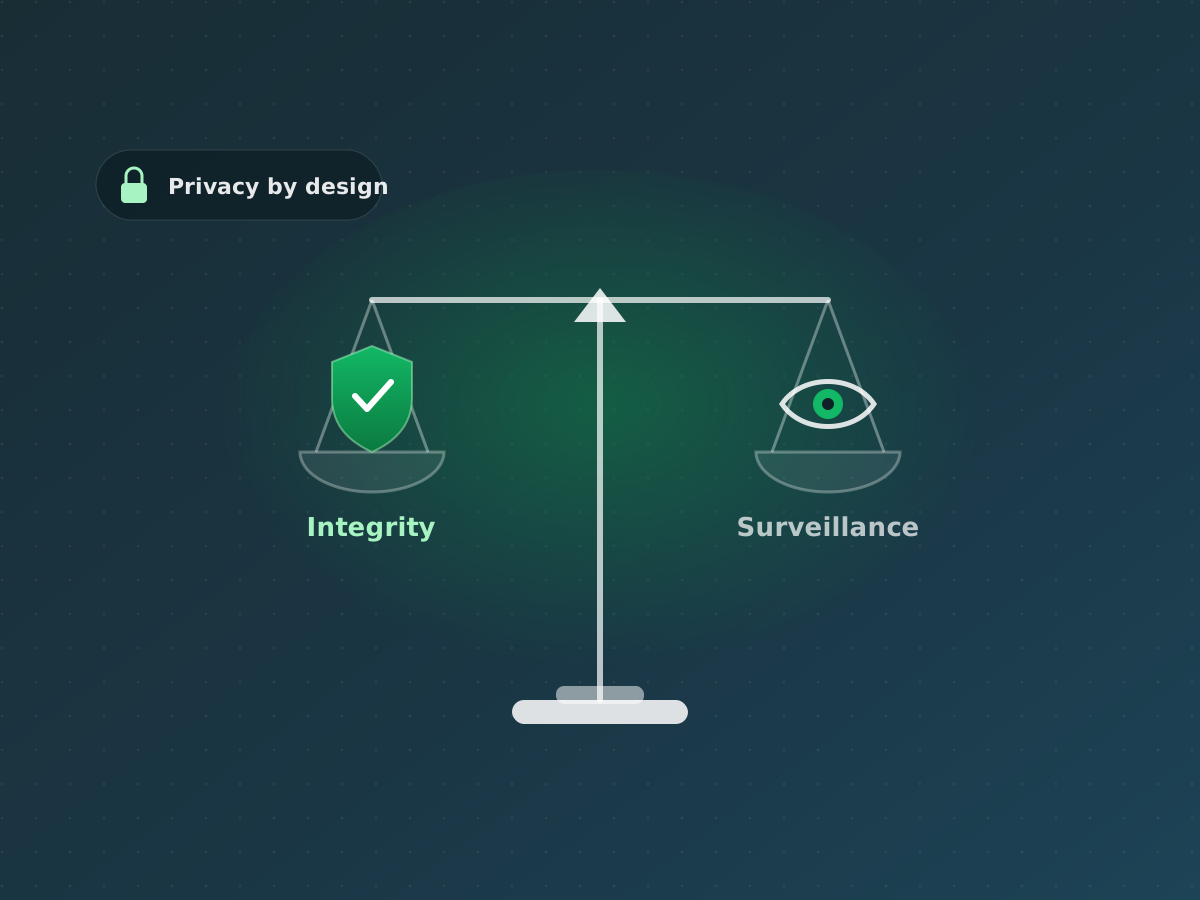
While monitoring is important, it is often reactive rather than preventive.
By the time suspicious behavior is detected, the integrity breach may have already occurred.
This becomes especially challenging in professional certifications where candidates are evaluated on specialized knowledge and problem-solving abilities. A few seconds of access to external resources can significantly alter assessment outcomes.
Secure browsers address this problem differently.
Instead of simply recording behavior, they actively restrict access to unauthorized tools before misuse occurs. This shifts assessment security from observation to prevention.
The goal is not just identifying misconduct. It is reducing the opportunity for misconduct altogether.
When AI Becomes a Browser-Based Threat
The rise of AI assistance has accelerated the need for secure browser environments.
In the past, candidates often needed separate devices or visible workarounds to access unauthorized help.
Today, assistance is available directly within the browser.
AI-powered extensions, writing assistants, coding helpers, and research tools can provide instant support during an assessment session.
This creates a significant challenge for certification providers.
A candidate can appear fully engaged while receiving real-time assistance that remains invisible to traditional monitoring systems.
For organizations managing high-stakes certifications, this is no longer an isolated concern. It is becoming a systemic risk.
This is where browser-level security becomes critical.
PEBble was designed specifically to address these modern assessment challenges. Rather than focusing solely on candidate observation, it creates a controlled testing environment by restricting unauthorized browser activities, limiting external resource access, and reducing opportunities for AI-assisted misconduct.
The focus shifts from detecting violations to preventing them from occurring in the first place.
The Overlooked Detail: Consistency Across Every Candidate
Most certification providers focus on identifying suspicious candidates.
Few focus on creating consistent assessment conditions for all candidates.
This distinction matters.
Without browser-level controls, candidates operate in vastly different environments. Some may have unrestricted access to digital resources, while others comply fully with assessment rules.
This creates inconsistencies that undermine fairness.
Secure browsers help standardize testing conditions by ensuring every participant operates within the same controlled framework.
PEBble strengthens this consistency through:
- browser lockdown capabilities,
- application restrictions,
- controlled navigation,
- secure assessment environments,
- and reduced access to unauthorized resources.
The result is not simply stronger security. It is greater fairness.
When every candidate faces the same digital conditions, certification outcomes become more defensible and more credible.
The Future of Remote Certification Integrity
Remote certifications will continue to expand across professional education, workforce development, compliance training, and industry licensing.
At the same time, assessment threats will continue to evolve.
AI tools will become more sophisticated. Browser-based assistance will become more seamless. Digital collaboration methods will become harder to detect.
In this environment, monitoring alone will not be enough.
Certification providers must move beyond observing behavior and begin controlling assessment environments.
Secure browsers represent that shift.
Solutions like PEBble demonstrate how modern certification security is evolving from passive monitoring toward proactive environment protection. By restricting unauthorized access, reducing AI-assisted opportunities, and creating consistent testing conditions, secure browsers help preserve the value of certifications in a rapidly changing digital landscape.
Because in remote certification programs, integrity is no longer defined by who is being monitored.
It is defined by what the browser allows them to do.