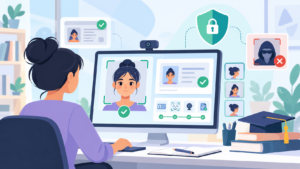
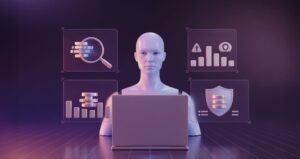
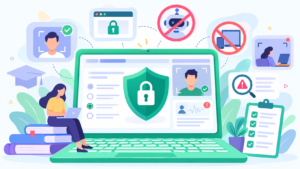
A student opens an online exam inside a locked browser. Their webcam is on, their identity has been checked, and the testing system appears secure.
But what if they have an AI assistant running on another device? What if an unauthorized application can read exam questions without opening another browser tab?
These examples show why universities need to rethink online exam security.
Artificial intelligence (AI) has changed how students find information, solve problems, and complete assessments. While AI can support learning, unauthorized assistance during an exam can make it harder to know whether a result reflects a student’s actual knowledge.
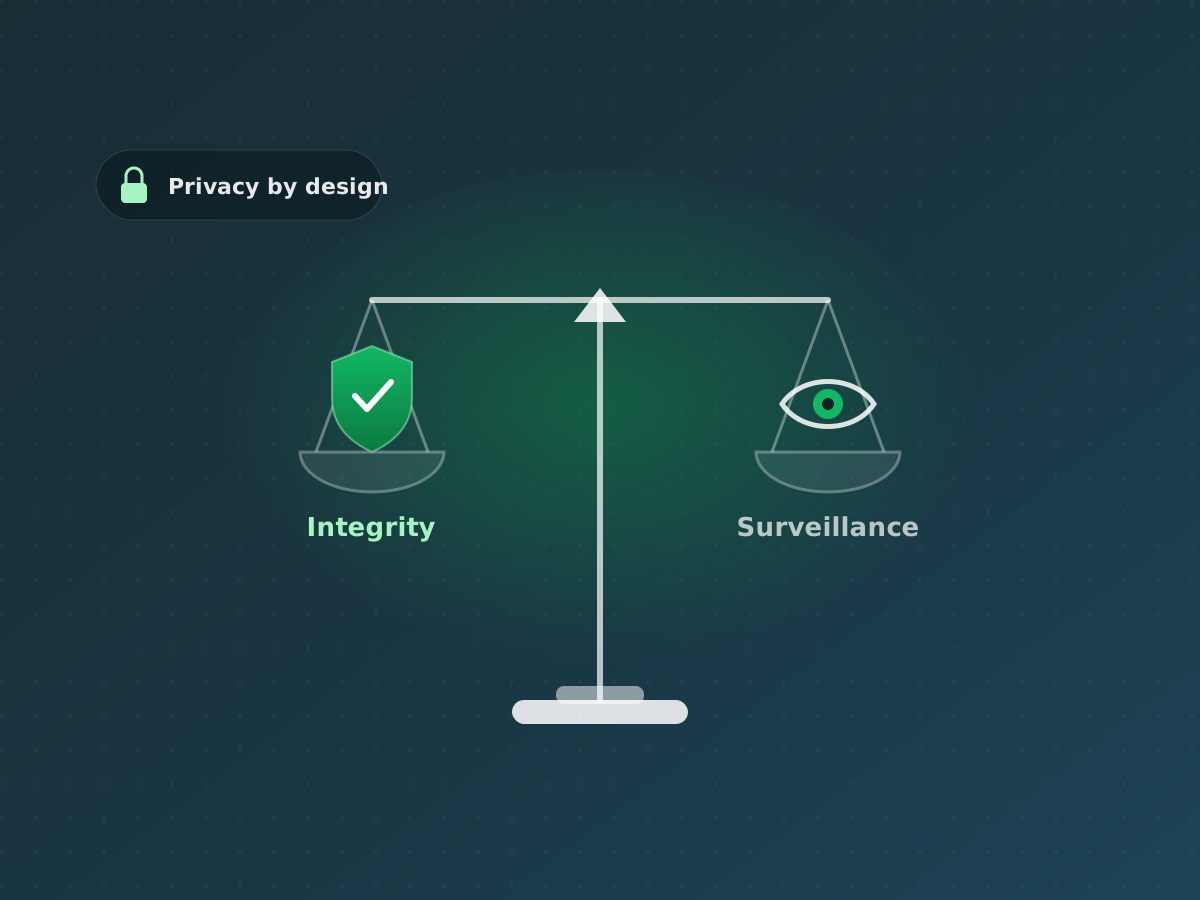
The answer is not simply adding more surveillance.
Universities need a careful combination of assessment design, identity verification, technical safeguards, human oversight, and student protections.
Here are 12 security controls every university should evaluate to make online exams more resistant to unauthorized AI assistance.
What Makes an Online Exam AI-Resistant?
An AI-resistant online exam is designed to reduce the risk of unauthorized AI assistance while still allowing students to demonstrate what they know.
It does not mean the exam is impossible to cheat on.
Traditional online exam security often focused on restricting websites, blocking copy-and-paste actions, and recording the test-taker.
These controls remain useful. However, AI assistance may also come from external applications, secondary devices, or another person using AI.
There is also an educational challenge: even strong technical security cannot fix an exam that fails to measure the intended skills.
In its September 2025 assessment reform guidance, Australia’s Tertiary Education Quality and Standards Agency (TEQSA) emphasizes trustworthy evidence of student learning and assessment redesign rather than relying mainly on detecting AI use.
For universities, the goal should be clear: reduce opportunities for unauthorized help, verify learning fairly, and make decisions using reliable evidence.
12 Security Controls for AI-Resistant Online Exams
1. Clear AI-Use Rules and Secure Assessment Design
What it protects: The validity of the exam itself.
Before choosing security software, universities should decide what AI use is allowed during each assessment.
For example, an AI tool might be permitted in a research assignment but prohibited during a closed-book clinical knowledge exam.
Instructions must explain these differences before the student starts.
Universities should also review whether exam questions measure real understanding. Applying knowledge to realistic situations, explaining decisions, and demonstrating practical skills can provide stronger evidence than questions that only require recalling facts.
For high-stakes learning outcomes, consider supervised practical tasks or brief oral follow-ups.
Evaluation question: Can we demonstrate that the assessment measures independent student knowledge under its stated AI-use rules?
2. Strong Identity Verification Before the Exam
What it protects: Against impersonation and unauthorized test-takers.
A university login confirms that someone has access to an account. It does not always prove that the enrolled student is the person taking the exam.
Identity verification may include a student ID check, facial matching, or another approved authentication method.
Institutions should evaluate accuracy, privacy requirements, accessibility, and the process for students whose identities cannot be verified automatically.
The NIST Digital Identity Guidelines provide a useful reference for understanding identity proofing and authentication, although they are not a universal compliance requirement for university exams.
Evaluation question: What happens when an identity check fails or an authorized student cannot complete biometric verification?
3. Identity Assurance Throughout the Exam
What it protects: Against unauthorized changes in who is taking the test.
Checking identity only at the beginning leaves a potential gap during longer assessments.
For example, a candidate may complete the initial verification but another person could attempt to take over later.
Depending on the exam’s risk level, universities can evaluate periodic or continuous identity assurance.
These systems may compare session images with an approved identity profile or flag unexpected changes for investigation.
However, a camera interruption, lighting change, or temporary absence should not automatically be treated as misconduct.
Evaluation question: How does the system verify identity during the exam, and what happens when the identity signal becomes uncertain?
4. Secure Browser Controls That Restrict Unauthorized AI Tools
What it protects: Against unauthorized resources on the testing device.
Browser lockdown remains an important layer of online exam security.
Depending on the technology, it can restrict access to external websites, new tabs, keyboard shortcuts, screen capture, and copy-and-paste functions.
But a basic browser lock may not address every AI assistant or application running outside the browser.
Universities should investigate how the testing environment handles unauthorized extensions, background applications, and approved educational tools.
They must also confirm that required accessibility software can continue working.
Evaluation question: Can the provider demonstrate which unauthorized tools are restricted, which remain outside its control, and which approved tools remain available?
5. Device and Operating System Security Checks
What it protects: Against hidden software-based assistance.
Some exam security risks exist outside the visible browser.
Examples include remote-access software, virtual machines, screen-sharing applications, and unauthorized background processes.
A virtual machine is software that creates a separate computer-like environment within a device. It can complicate how an examination system observes device activity.
Universities should evaluate whether their security controls can identify or restrict prohibited software without disrupting legitimate system functions.
They should also assess compatibility with student-owned laptops, campus computers, and approved accessibility technologies.
Evaluation question: Has the institution tested the security controls against the specific device configurations and unauthorized applications relevant to its exams?
6. Secondary Device and Testing Environment Controls
What it protects: Against off-screen assistance.
A locked laptop cannot control an AI application running on a nearby smartphone.
This is why universities should not assume that browser restrictions alone address second-screen cheating.
Depending on exam risk, institutions may use clear device rules, workspace checks, appropriate camera coverage, or additional supervision.
For high-stakes assessments, a secondary camera may provide another view of the testing environment.
However, cameras have blind spots, and no room scan can guarantee that every hidden device is found.
Universities must also respect student privacy and ensure that monitoring requirements are proportionate.
Evaluation question: What evidence can the examination process provide about prohibited secondary-device use, and what activity remains outside its visibility?
7. Exam Question and Content Protection
What it protects: Against leaked questions and advance access to answers.
Even strong proctoring controls lose value if the exam questions are already publicly available.
Universities should consider question banks, randomized question selection, alternative assessment versions, and regular item reviews.
They should also investigate unusual patterns, such as several candidates providing highly similar answers to questions that require independent reasoning.
For important examinations, question exposure should trigger an agreed process for reviewing, replacing, or retiring affected items.
Randomization alone does not guarantee security, especially when question banks are small.
Evaluation question: How does the university identify exposed questions, manage its question bank, and investigate unusual response patterns?
8. AI-Assisted Monitoring With Clear Limits
What it protects: Against suspicious activity that may need investigation.
Automated monitoring can help examination teams manage large numbers of remote sessions.
Depending on the system, it may flag events involving unexpected faces, unusual audio, prohibited applications, or interruptions in camera visibility.
However, these events are not proof of cheating.
A student looking away may be thinking. Background noise may come from a shared household. Unusual movement may reflect a disability or an approved accommodation.
Universities should treat automated alerts as starting points for review, not final conclusions.
Evaluation question: Can the provider explain what triggers each alert and show evidence of how reliably its alerts identify relevant events?
9. Human Review and Appropriate Live Intervention
What it protects: Against incorrect automated decisions and unresolved incidents.
AI can help identify events that deserve attention, but human judgment remains essential.
Universities should determine which assessments need live proctors, which can use automated monitoring with later review, and which require only lighter safeguards.
They should also define how an incident is escalated.
For example, when monitoring detects an unexpected person, the appropriate response may be to request clarification rather than immediately ending the exam.
Human reviewers need clear policies, training, and access to relevant evidence.
Evaluation question: Who reviews suspicious events, when can a live proctor intervene, and who has authority to make the final academic integrity decision?
10. Reliable Evidence, Reporting, and Student Appeals
What it protects: The fairness and defensibility of exam integrity decisions.
An unexplained risk score is not enough to support a serious misconduct finding.
Examination teams need relevant evidence that can be reviewed in context.
Useful records may include timestamps, selected video or screen recordings, system events, and notes explaining why an incident was flagged.
Universities should define who can access these records, how they are protected against unauthorized changes, and how long they are retained.
Students must also have a fair opportunity to respond to allegations.
Evaluation question: Can the institution reconstruct an incident, explain its decision, and support a fair appeal without relying entirely on an automated score?
11. Privacy, Data Protection, and Responsible AI
What it protects: Student information and institutional trust.
Online proctoring may involve personal information such as identity documents, facial images, audio, video, and details of the testing environment.
Universities should not collect or retain this information without a clear reason.
They need to understand what data is required, where it is processed, who can access it, when it is deleted, and what happens if a student raises a privacy concern.
The UNESCO Guidance for Generative AI in Education and Research provides broader guidance on responsible, human-centered AI use.
Legal obligations depend on the institution’s location, the type of data collected, and applicable laws.
Evaluation question: Can the provider demonstrate appropriate privacy controls, explain its AI practices, and support the university’s data protection requirements?
12. Accessibility, Accommodations, and Exam Continuity
What it protects: Fair access to assessments and reliable exam completion.
Security is not effective if authorized students cannot complete their exams.
Universities need to test compatibility with assistive technologies, approved breaks, extra-time accommodations, and alternative examination arrangements.
The Web Content Accessibility Guidelines (WCAG) 2.2 provide an important reference for evaluating accessible digital experiences.
Operational reliability also matters.
If a student’s internet connection fails, the university should have an established process for pausing, resuming, or rescheduling the exam.
A technical failure must not automatically become a misconduct allegation.
Evaluation question: Can students with different accessibility, device, and connectivity needs complete the exam fairly without weakening the institution’s assessment standards?
How Universities Can Evaluate These 12 Controls Before Choosing a Solution
A long list of features does not prove that an examination system is effective.
Universities should ask providers to demonstrate how their controls work in realistic situations.
Start by testing four scenarios:
| Test scenario | What the university should evaluate |
|---|---|
| An unauthorized AI tool runs on the exam computer | Whether relevant restrictions or alerts work as described |
| A student attempts to use another device | What the monitoring system can and cannot observe |
| A student uses approved assistive technology | Whether the exam remains accessible and avoids inappropriate alerts |
| A connection fails during an examination | Whether the incident is documented and exam recovery works fairly |
A simple evaluation method is to score each of the 12 controls:
- 0 — Not demonstrated: The provider cannot show evidence that the control works.
- 1 — Partly demonstrated: The control works only under limited conditions or requires unresolved changes.
- 2 — Demonstrated: The control meets the university’s defined requirements during testing.
The maximum score is 24, but the total should not determine the decision on its own.
A failure involving student accessibility, privacy, essential identity checks, or fair incident review may be unacceptable even when other controls score well.
For the best result, involve IT security, academic integrity, examination operations, faculty, disability support, and privacy teams in the evaluation.
Match Security to the Stakes of the Exam
Not every examination needs identical monitoring.
A weekly practice quiz may need clear AI-use rules and good question design.
A final examination that determines course progression may justify stronger identity controls and incident review.
A high-stakes professional qualification may require more extensive technical safeguards, human supervision, and evidence handling.
The right balance depends on what the assessment measures, the consequences of an unreliable result, and the burden placed on students.
Where Proctortrack Fits Into a Layered Exam Security Strategy
A layered approach combines controls that address different risks instead of expecting one feature to solve every problem.
Proctortrack supports this approach through capabilities such as identity verification, secure testing environments, automated monitoring, live proctoring, and incident review.
Its PEBble secure browser is designed to address unauthorized applications and AI-enabled assistance within the supported testing environment. Proctortrack also offers different proctoring levels, allowing institutions to evaluate which approach suits their assessment needs.
These capabilities should be reviewed alongside institutional assessment policies, accessibility requirements, and practical testing results. Features and configurations may vary by solution level.
The important question is not simply how many security features a platform offers. It is whether those features work together to address the university’s actual risks.
Final Thoughts: AI-Resistant Exams Need More Than AI Detection
AI has made examination security more complex, but it has also created an opportunity for universities to improve how they assess learning.
The strongest approach begins with clear assessment rules and meaningful questions. It then adds identity assurance, secure technology, appropriate monitoring, human judgment, and student protections.
No single control can stop every form of unauthorized assistance.
Universities should prioritize controls that can be demonstrated, measured, and defended when questioned.
The goal is not to monitor every student more closely. It is to produce trustworthy exam results while treating every student fairly.
Explore Proctortrack’s online proctoring options to learn how layered examination security can support different institutional assessment needs.