Autonomous vehicles are designed to navigate roads without a human driver behind the wheel. But what happens when a self-driving vehicle encounters a situation it cannot confidently resolve?
In many cases, the answer involves a human working remotely.
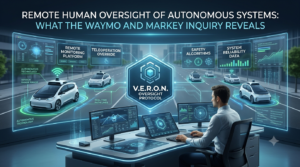
Remote assistance operators help autonomous vehicles understand unusual road conditions, interpret complex situations, and decide how to proceed. Their role is an important part of today’s autonomous mobility ecosystem, but it also raises questions about safety, transparency, accountability, and the true level of vehicle autonomy.
In February 2026, U.S. Senator Ed Markey opened an inquiry into the remote human assistance practices of seven autonomous vehicle companies. The findings, published on March 31, brought an important issue into focus: autonomous systems may operate independently for much of the time, but human oversight remains part of the operational picture.
For robotics and mobility leaders, the inquiry offers lessons that extend beyond robotaxis to any autonomous system supported by remote human operators.
What Did the Markey Inquiry Find?
On February 3, 2026, Senator Markey sent letters to seven autonomous vehicle companies: Waymo, Tesla, Zoox, Aurora, Motional, May Mobility, and Nuro.
The inquiry requested information about how companies use Remote Assistance Operators (RAOs), including their responsibilities, qualifications, locations, response times, intervention frequency, and safety procedures.
A Senate Commerce Committee hearing followed on February 4. During the hearing, Waymo’s Chief Safety Officer discussed the company’s use of remote assistance personnel, including workers based in the Philippines.
The investigation subsequently revealed several important findings:
- Remote human support is part of autonomous vehicle operations: Companies use remote personnel to help vehicles navigate difficult or uncertain situations.
- Waymo disclosed its workforce scale: The company reported approximately 70 remote assistance agents on duty worldwide at any given time, supporting a fleet of around 3,000 robotaxis.
- Remote assistance does not necessarily mean remote driving: Waymo stated that its agents provide advice and support to the Waymo Driver rather than directly controlling the vehicle.
- Intervention frequency remained undisclosed: None of the seven companies disclosed how frequently remote assistance operators intervene to help their autonomous vehicles.
- Practices differ across companies: The responses revealed variations in operator qualifications, response times, overseas staffing, and other operational safeguards.
The central issue was not simply whether humans support autonomous vehicles. It was whether companies could demonstrate how that support works and how its risks are managed.
Why Does Transparency Matter?
Autonomous mobility depends on public confidence. Passengers, regulators, road users, and transport authorities need to understand how vehicles behave when their automated systems encounter situations outside their normal operating conditions.
Without transparent information, several important questions remain unanswered.
1. How often do vehicles need human assistance?
Intervention frequency can help explain how well an autonomous system handles real-world conditions. A vehicle that frequently requests assistance may have different operational limitations from one that rarely needs support.
However, intervention frequency must be interpreted carefully. A request for clarification does not necessarily mean the vehicle has failed or that a human has taken control.
2. How quickly can remote operators respond?
Communication delays matter when a vehicle is waiting for guidance in a complex or potentially hazardous situation.
Companies need to understand the time between a vehicle requesting assistance, an operator responding, and the autonomous system acting on that guidance.
A remote assistance process should also define what happens when connectivity is delayed, interrupted, or unavailable.
3. Who is responsible for the decision?
Remote operators may provide information or recommendations, while the autonomous driving system remains responsible for vehicle movement.
Clear boundaries are essential. Companies should define which decisions remain with the autonomous system, which situations require human input, and when an incident must be escalated.
4. How is sensitive information protected?
Remote assistance may involve access to camera feeds, audio, location information, and other vehicle data.
Organizations must establish clear policies for operator access, data retention, cybersecurity, monitoring, and privacy protection.
What Could Verifiable Human Oversight Look Like?
The inquiry highlights the need for more than a general statement that humans are monitoring autonomous systems. Effective oversight should be measurable, documented, and independently reviewable.
A practical framework could include the following elements:
1. Defined intervention boundaries
Every autonomous operation should have documented rules explaining what remote operators can and cannot do.
For example, an operator might be permitted to provide contextual information or guidance but not directly control vehicle steering, acceleration, or braking.
These boundaries should be clear to operators, engineering teams, safety managers, and regulators.
2. Complete intervention records
Each assistance session should generate a traceable record containing:
- Vehicle and session identification
- Reason for the assistance request
- Time the request was generated
- Time an operator responded
- Guidance or information provided
- Whether the autonomous system accepted or rejected the guidance
- Final outcome and escalation details
These records can help organizations investigate incidents and identify recurring operational weaknesses.
3. Operator qualification and performance monitoring
Remote operators need appropriate training for the systems and environments they support.
Organizations should document training requirements, qualification checks, refresher programs, supervision procedures, and performance reviews.
Workload, fatigue, distractions, and communication quality should also be considered.
4. Connectivity and fallback procedures
Remote assistance systems should have defined response-time expectations and escalation procedures.
If an operator cannot respond or communication is lost, the autonomous system must have a safe fallback strategy appropriate to its operating environment.
A vehicle should not depend on an unavailable remote operator as its only safety measure.
5. Auditable safety and privacy controls
Organizations should maintain evidence that oversight procedures are followed.
Access controls, cybersecurity protections, data retention rules, incident reviews, and regular audits can help demonstrate that remote support is operating within approved boundaries.
Lessons for Any Remotely Supported Robot
Although the Markey inquiry focused on autonomous vehicles, its lessons apply to a much wider range of robotics applications.
Industrial robots, warehouse automation systems, delivery robots, agricultural machines, and autonomous mobile platforms may all require human assistance when they encounter unexpected conditions.
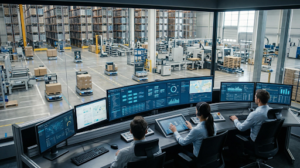
For example, a warehouse robot might need help when an aisle becomes blocked. An agricultural robot could require guidance when terrain or environmental conditions change. An industrial system may need a human operator to review an unusual situation before continuing.
In each case, the organization should be able to answer four fundamental questions:
- What triggered the request for human assistance?
- Who provided the assistance, and were they qualified?
- What action or guidance was provided?
- Can the organization verify the outcome afterward?
This is where human-in-the-loop operations become especially important. The objective is not to remove people from autonomous operations. It is to make human involvement structured, accountable, and measurable.
The V.E.R.O.N. Perspective: Making Human Oversight Verifiable
The future of autonomous systems will depend not only on how intelligently machines operate, but also on how reliably organizations manage the people and processes supporting them.
The Markey inquiry demonstrates why remote assistance should be treated as a defined operational capability rather than an informal backup arrangement.
For robotics companies, this means building oversight processes around clear responsibilities, traceable interventions, operator readiness, escalation procedures, and measurable performance.
V.E.R.O.N. (Verified Robotics Operations Network) focuses on the operational layer that supports human-in-the-loop robotics. By examining remote monitoring, teleoperations, exception handling, fleet operations, and operational quality assurance, organizations can identify gaps in how their robotic systems are supervised and supported.
The broader lesson is straightforward: autonomy does not eliminate the need for accountability. As autonomous fleets expand, the human support behind them must become just as transparent and verifiable as the technology itself.
Conclusion
The Waymo and Markey inquiry has brought an important question to the forefront of autonomous mobility: how much human assistance do autonomous systems need, and can that assistance be independently understood and evaluated?
The findings do not mean that autonomous vehicles are simply being driven remotely. They show that remote human assistance is an important part of the operating model and that companies need clearer ways to demonstrate how it works.
For mobility and robotics leaders, the opportunity is to build oversight systems that are measurable, secure, documented, and ready for independent review.
Subscribe for trusted robotics insights from V.E.R.O.N. and explore our next article on human-in-the-loop robotics operations.