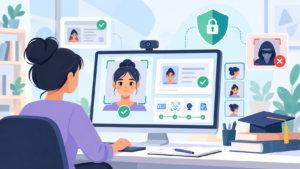
As online education, professional certifications, and remote assessments continue to expand globally, organizations face a growing challenge: how to deliver secure online exams across multiple time zones without compromising exam integrity.
Traditional fixed testing windows are no longer practical for international candidates. Today, successful global online exam scheduling requires a balance between flexibility, fairness, and security. Institutions must provide equal testing opportunities while protecting item banks, maintaining psychometric integrity, and preventing exam content leaks.
In this blog, we’ll explore the best practices for testing across time zones, including content exposure control, randomized item delivery, secure online proctoring, and operational strategies that help organizations conduct fair and secure global assessments.
Balancing Time-Zone Fairness with Online Exam Security
One of the biggest challenges in global online exam scheduling is ensuring that candidates from different countries can take exams at convenient local times.
Providing time-zone fairness improves:
- Candidate experience
- Exam accessibility
- Participation rates
- Overall fairness in assessments
However, multiple testing windows also increase the risk of exam content exposure.
If candidates who finish early share exam questions with later test takers, the validity of the assessment can be compromised.
To minimize this risk, institutions should implement:
- Randomized item delivery
- Parallel exam forms
- AI-generated assessment items
- Secure online proctoring
- Strong content exposure controls
These strategies help maintain online exam integrity while giving candidates greater scheduling flexibility.
Randomized Item Delivery and Content Exposure Control
Effective online assessment security depends on protecting exam content throughout the testing window.
Randomized item delivery is one of the most effective methods for reducing cheating and unauthorized content sharing.
Instead of presenting identical questions to every candidate, modern testing platforms use intelligent item selection to generate unique exams.
Key security practices include:
Randomized Question Delivery
Each candidate receives questions in a different order, making collaboration significantly more difficult.
Parallel Exam Forms
Multiple equivalent exam versions help reduce question exposure while maintaining the same difficulty level and learning outcomes.
AI-Generated Assessment Items
Artificial Intelligence can generate additional validated assessment questions that expand the item bank and reduce repeated exposure.
Content Exposure Analytics
Advanced analytics monitor:
- Suspicious answer patterns
- Unusual retake behavior
- Potential item exposure
- Exam security risks
Institutions can quickly retire compromised questions and replace them with secure alternatives.
Together, these strategies strengthen content exposure control and protect item bank security across global testing windows.
Operational Planning for Secure Global Online Exams
Technology alone cannot guarantee secure online assessments.
Successful global online exam delivery also requires strong operational planning.
Proctor Coverage Across Time Zones
Candidates should receive the same secure testing experience regardless of their location.
Effective proctor coverage planning ensures:
- Consistent monitoring
- Equal exam standards
- Rapid incident response
- Better candidate support
Solutions like Proctortrack combine AI-powered monitoring with live online proctoring to support secure assessments across multiple time zones.
Clear Retake Policies
Well-defined retake policies are essential for maintaining fairness.
Institutions should clearly establish:
- Retake eligibility
- Waiting periods
- Security verification
- Monitoring requirements
Strong retake policies help prevent candidates from exploiting multiple testing windows.
Standardized Global Exam Operations
Standardized procedures ensure consistent assessment quality across all regions.
Institutions should maintain:
- Uniform security protocols
- Consistent candidate verification
- Standardized proctoring procedures
- Centralized monitoring systems
These practices improve online exam security while supporting a fair testing experience.
Protecting Psychometric Integrity Through Smart Assessment Design
A secure online assessment must also remain scientifically valid.
Maintaining psychometric integrity ensures every candidate is evaluated fairly regardless of when or where they take the exam.
Equitable Parallel Forms
Every exam version should measure the same learning outcomes with equivalent difficulty levels.
Validated AI-Generated Questions
AI-generated assessment items should undergo quality assurance to verify:
- Difficulty level
- Reliability
- Discrimination index
- Learning objective alignment
Layered Security for Item Banks
Strong item bank security includes:
- Short testing windows
- Randomized question delivery
- Content rotation
- Secure storage
- Early retirement of exposed questions
Transparent Candidate Communication
Candidates are more likely to trust secure testing systems when institutions clearly explain:
- Time-zone scheduling
- Security measures
- Proctoring procedures
- Retake policies
Transparency improves both candidate confidence and overall academic integrity.
Conclusion
Conducting online exams across multiple time zones requires much more than flexible scheduling.
Successful global online exam scheduling combines time-zone fairness, online exam security, content exposure control, and psychometric integrity into one comprehensive strategy.
By using:
- Randomized item delivery
- Parallel exam forms
- AI-generated assessment items
- Secure online proctoring
- Strong item bank security
- Effective proctor coverage planning
organizations can deliver secure, fair, and reliable assessments to candidates worldwide.
Solutions like Proctortrack help institutions maintain academic integrity while simplifying secure online testing across global learning environments.
With the right technology, operational planning, and assessment design, organizations can confidently protect exam credibility without sacrificing flexibility for international learners.