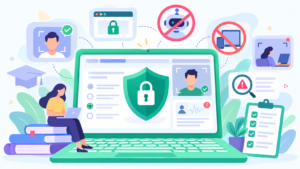
For years, institutions have responded to cheating by making exams harder. Questions become more analytical, case studies grow more complex, and assessments shift from memorization to critical thinking.
Yet one risk continues to grow regardless of exam difficulty: impersonation.
A highly secure exam can still produce unreliable results if the person taking it is not the registered candidate. In today’s remote assessment environment, the biggest integrity threat is often not how difficult the questions are—it is whether the institution can confidently verify who is answering them.
This shifts the conversation entirely. Assessment integrity is no longer measured only by the quality of the questions. It is measured by the authenticity of the person completing them.
The First Miscalculation: Assuming Harder Exams Prevent Cheating
Many institutions believe increasing question difficulty automatically improves exam security.
Complex scenarios, open-ended questions, and problem-solving exercises certainly make assessments more challenging. However, they do little to stop someone else from taking the exam on behalf of a candidate.
An experienced proxy test-taker can often complete difficult assessments more effectively than the registered candidate.
This creates a serious integrity gap.
The challenge is no longer whether the exam measures knowledge. It is whether it measures the right person’s knowledge.
Without reliable identity verification, even the most sophisticated assessment loses credibility.
The Micro Gap: Impersonation Is Becoming Less Visible
Traditional exam fraud often involved visible misconduct such as hidden notes or unauthorized materials.
Remote assessments have introduced a different challenge.
Today, impersonation can occur through:
- proxy test-takers,
- shared credentials,
- identity swapping during long assessments,
- and coordinated assistance from external individuals.
Unlike traditional cheating, impersonation may leave very few obvious signs.
The candidate on camera may appear confident.
The responses may be accurate.
The assessment may proceed without interruption.
The problem is that institutions may be evaluating someone who should never have been taking the exam in the first place.
This is particularly concerning for professional certifications, licensing programs, and workforce assessments where decisions directly affect employment and public trust.
When Question Difficulty Becomes Irrelevant
Many organizations continue investing heavily in designing more difficult assessments.
But question difficulty becomes meaningless when candidate identity cannot be verified.
A technically challenging certification exam offers little value if:
- credentials are shared,
- proxy candidates participate,
- or identity changes during the assessment.
This creates a false sense of security.
Institutions may believe assessment quality has improved because questions are more advanced, while overlooking the more fundamental question:
Who actually completed the assessment?
Identity verification shifts the focus from protecting questions to protecting outcomes.
Instead of assuming the right person is present, institutions begin validating that assumption throughout the assessment process.
The Overlooked Detail: Identity Is Not a One-Time Event
Many assessment systems verify identity only once at login.
After authentication, identity is often assumed to remain unchanged for the rest of the session.
This assumption creates one of the biggest blind spots in remote assessments.
Long-duration exams create opportunities for:
- temporary candidate substitutions,
- off-camera assistance,
- or identity changes during connectivity interruptions.
A single login verification cannot guarantee continuous authenticity.
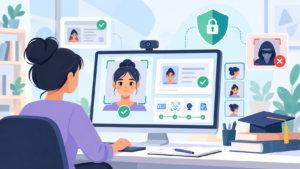
Modern assessment integrity requires identity verification to become an ongoing process rather than a one-time checkpoint.
Continuous validation helps ensure that the same individual who begins the assessment remains present until it is completed.
This approach strengthens trust without relying solely on increasingly difficult exam content.
The Future of Assessment Integrity
The future of assessment security will not be determined by who writes the toughest questions.
It will be determined by who can confidently verify candidate authenticity.
As remote assessments continue expanding across education, professional licensing, certifications, and workforce evaluations, identity verification will become more important than ever.
Harder exams will always have value.
But they cannot compensate for uncertainty about who is actually taking them.
The institutions that succeed will move beyond designing difficult assessments and focus on building trusted assessment environments where identity is continuously verified and integrity is preserved from start to finish.
Because the credibility of an exam is not defined by how difficult the questions are.
It is defined by knowing that the right person answered them.